Home · Services · Events & webinars

Registration campaigns that fill events on schedule

An event has one date. Registrations either arrive before it or they're worthless - which makes this the least forgiving kind of lead generation there is.

Book a free 30-minute audit

Where this comes from

75,000+ registrations, cycle after cycle

Hack2Skill · Tech & AI events · Meta lead generation

75K+ registrations at ₹7–16 each

Hackathons and AI programs - India Runs, Build With AI - filled repeatedly, with cost per completed registration held down across cycles rather than on one lucky campaign.

75K+total registrations
₹7–16per completed registration
Repeatheld across event cycles

Source: Meta Ads Manager

Situation → Result + proof

Situation. A tech events platform running hackathons and AI programs on a continuous calendar, needing large registration volume against a hard cost-per-signup ceiling.

Need. Fill each event on schedule without cost per registration drifting upward as volume climbed and as the same audience saw campaign after campaign.

Action. Optimized on completed registrations rather than clicks or landing page views, ran a continuous audience and creative testing loop so each cycle started from the last one's learnings, and stripped friction out of the registration page and form at every step.

Result. 75K+ registrations, with completed signups as low as ₹7–16.
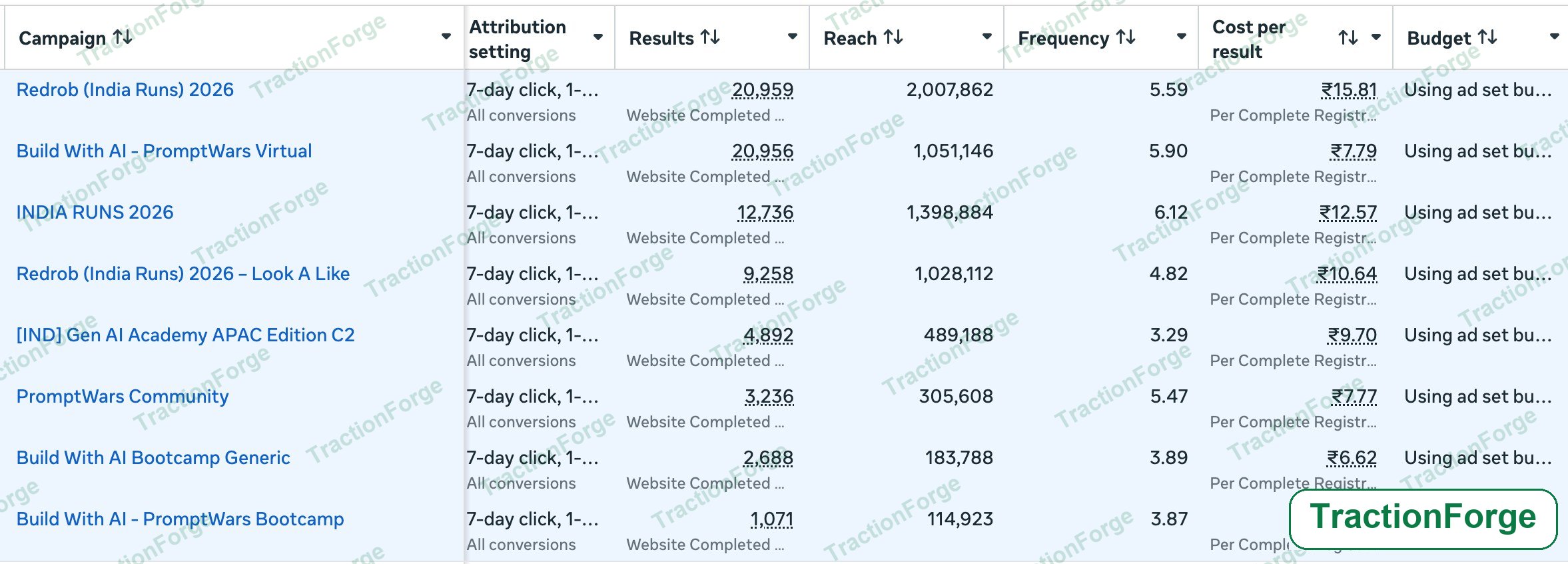
Meta Ads Manager showing 20,959 registrations at ₹15.81 each Meta Ads Manager - 20,959 registrations at ₹15.81 each on a single campaign

Why events break differently

A deadline you can't negotiate with

Four failure modes that only exist when there's a fixed date at the end of the campaign.

The learning phase eats your runway

Campaigns need conversions before they optimize. On a three-week promotion, a slow start means the algorithm gets good roughly when the event ends.

Registrations aren't attendance

Free events routinely see half the registrants never show. Optimizing on signups alone can quietly buy you a bigger no-show list.

Creative fatigue arrives fast

Short bursts against a defined audience burn through creative in days. Frequency climbs, cost per registration follows it up.

Every cycle starts from zero

Most teams rebuild from scratch each event. Nothing compounds, so the tenth event costs the same as the first.

The Hack2Skill result came from fixing the fourth one - each cycle inheriting the last one's learnings instead of restarting.

What we run

Built to be run again next month

How an event engagement runs

Working backwards from the date

  1. 01

    Target & runway

    How many registrations, by when, at what cost - and how many days there actually are. That determines whether we have time to let campaigns learn or need to buy the signal fast.

  2. 02

    Tracking & page

    Registration conversion firing correctly, page and form stripped down, reminder sequence built. Done before spend starts, because fixing tracking mid-campaign wastes the runway.

  3. 03

    Launch & rotate

    Multiple creative angles live from day one, with a rotation schedule set against expected frequency. Daily monitoring in the first week, when the cost curve is still settling.

  4. 04

    Close & carry forward

    Final-days urgency push, then a post-event readout: cost per registration, show-up rate, best angles - and audiences saved so the next cycle starts ahead.

If you run events on a calendar rather than one-off, the second cycle should always be cheaper than the first.

Event questions

What event teams ask

How far ahead should we start promoting?
Three to four weeks for a free online event, six or more for anything paid or requiring travel. The constraint is the learning phase - campaigns need a volume of conversions before costs settle, and a short runway means paying learning-phase prices for the entire promotion.
Can you hit a specific cost per registration?
We'll set a target from your event type, audience size and runway, and report against it from day one. The ₹7–16 range on Hack2Skill came from high-volume free tech events with a well-defined audience and repeated cycles - a paid conference for senior buyers is a different economy entirely, and we'd say so upfront rather than quote you that number.
Our registrations are fine but nobody shows up.
Usually three things: the ad promised something the event doesn't deliver, there's no reminder sequence, or the registration was so frictionless it carried no commitment. All three are fixable, and the fix is often adding a small amount of friction back.
Meta or Google for events?
Meta for almost all of it. Event demand rarely exists in search - people aren't looking for your hackathon by name - so you're creating demand, which is what Meta does well. Google search is worth running only for branded terms or well-established recurring events.
We run events every month. Does that change anything?
It changes everything, and in your favour. Recurring events let audiences, creative and conversion data compound across cycles - past registrants are the cheapest source for the next event, and lookalikes get better every round. This is where the biggest cost reductions come from.

Filling an event on a deadline?

Book a free 30-minute audit. We'll look at your registration page, tracking and runway, and tell you what's realistic at the cost you're aiming for.